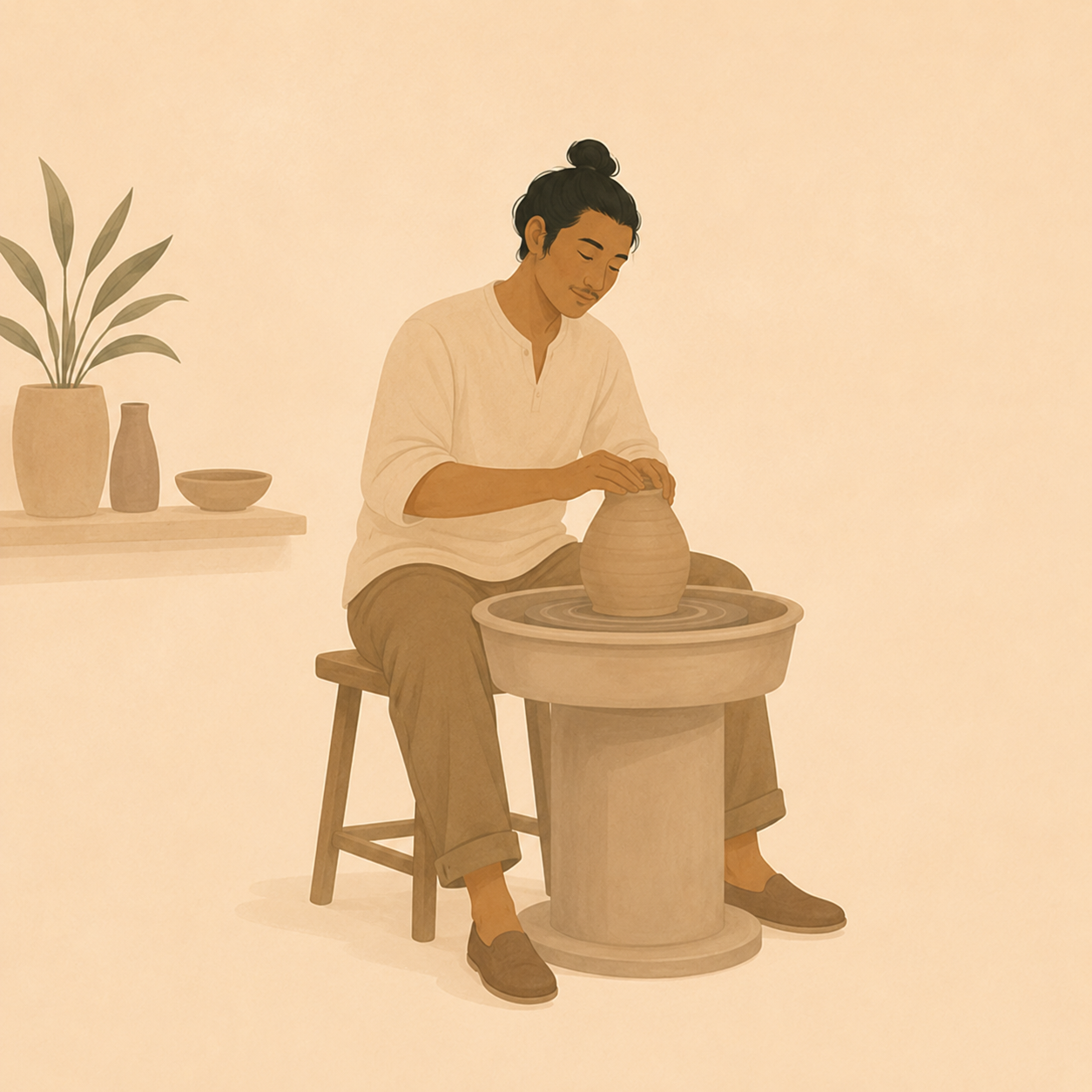
The clay is leaning to the left. You thought it would become a bowl, and perhaps it will, in the loose sense that it has a hollow and could hold three almonds. Across the table, a teenager draws a clean curve with her thumb. Your hands, once so certain in their usual occupations, are making a small, damp argument with gravity.
“You can start again,” the teacher says. She means the clay. You hear a verdict on your whole adulthood.
Darling, may I sit beside that wobbly bowl? I’m Camilla Wellton. I know how quickly a new pleasure can be spoiled by the demand to look competent. You came to touch clay, not to defend your curriculum vitae. Yet the mind can turn even a Saturday class into an examination. If you have ever fled a room because you were not instantly good at the thing you came to learn, pull up a stool.
The peculiar humiliation of a first attempt
Children are expected to fall while learning to walk, though even children do not always enjoy being watched. Adults have acquired a longer list of things we can do, and the list can become a fence. We do not mind learning, in theory. We mind the unmistakable sight of ourselves before learning has happened.
You may be brilliant at raising a child, fixing a bicycle, keeping accounts, or hearing the undertone in a friend’s voice. None of those gifts will persuade wet clay to obey your first touch. This is not because your intelligence has deserted you. It is because the knowledge you need has not yet reached your fingers. What a relief it might be to let that be true.
Still, shame can arrive with surprising speed. “I’m not artistic.” “I have no coordination.” “I knew this would be embarrassing.” Notice how swiftly a crooked bowl becomes a statement about identity. A thing happened on a table. Your mind has drafted a biography.
One of the books in my Sensual Hero’s Journey, That’s Not Me, asks what happens when the qualities we have practised for survival come to stand in for the whole of us. In this class, “I am the capable one” may be such a quality. It has helped you. Perhaps other people count on it. But when that role insists you cannot be seen making a beginner’s bowl, it also decides where you are allowed to grow.
You do not have to renounce competence to keep learning. You can put it down for an hour, like a heavy bag you have carried all morning. The person beneath it may be curious.
The teacher sees a bowl
Watch the teacher’s hands. She does not mourn each lump of clay. She shows you how to brace one hand and let the other move more slowly. “There,” she says when the wall rises a little. Her standard is neither humiliation nor flattery. She is interested in what the material is doing.
There is a wonderful discipline in that kind of attention. She is not asking, “What kind of person makes a lopsided bowl?” She asks, “What happens if your thumb rests here?” The question is small enough to answer. It gives you a next move, and a next move is often all a beginner needs.
Many of us have learned to make an error mean a great deal before we have learned from it. A missed note in a choir becomes proof that we should never sing aloud. A wrong turn in a new city confirms we are hopeless at directions. A sentence pronounced awkwardly in another language becomes a reason to keep speaking only the one we know. The leap is so quick that it can masquerade as accuracy. It is actually a refusal to stay with the particular.
Try making the claim smaller. “This wall collapsed when I pressed too hard.” “I lost the melody after the second verse.” “I don’t know how to ask for the station yet.” These sentences leave you with something to work on. “I am bad at this” closes the book at page one.
You can have rooms you have not entered
In my Hidden Hero’s Journey books, the House gives identity the form of rooms, doors, and arrangements. Some rooms feel familiar; others seem to belong to people unlike us. I like that image in a pottery class. Perhaps you have lived in the room called Competent for so long that the door to Beginner looks like an exit from the house. It isn’t. It is another room in the same life.
Who told you that the adults in your family must know what they are doing? Maybe it was not said. Maybe you watched people hide uncertainty because money was short or mistakes were expensive. Their care may have taught you much, including habits that now make play feel unsafe. You can respect what those habits protected and still ask whether a class on Saturday requires the same armour.
Of course, not every room is equally welcoming. Some people are judged more harshly when they make mistakes. Race, class, accent, disability, age, and gender can change the cost of being visible as a learner. I will not ask you to pretend the room is fair when it is not. Part of choosing a place to learn is choosing a teacher and companions who will not turn uncertainty into a spectacle. Permission to begin is easier to feel when the conditions around you honour it.
If this teacher does not, you are allowed to find another. Being a beginner does not mean surrendering your judgment. You can know little about clay and still know when someone is being careless with you.
Take the bowl home
At the end of class, the teenager’s bowl is elegant. Yours has a lip that rises on one side like an eyebrow. You could leave it behind. You could tell a charming story about how terrible you are. Perhaps instead you place your name under it and let it be fired.
When it comes home, use it. Put your keys in it, or those three almonds. The point is not to display proof of natural talent. The bowl records an afternoon in which you stayed long enough for your hands to learn something. It will remind you that embarrassment can be survived, and that you can return without first becoming impressive.
Then perhaps you will take another class. Perhaps you will decide pottery is not yours and try singing, swimming, or a language you always wanted to hear on your own tongue. A first attempt does not oblige you to become devoted. It gives you information about the experience. You are free to choose again from what you have actually felt.
I love the moment when a person’s face changes from “I should already know” to “Oh, that is how it works.” It is a small revolution. The world has not changed its laws, but one of them has become available to your hands. That is enough reason to begin badly, beautifully, and as many times as you need.