
The first thing to notice about a Selam Fessahaye suit may be its shoulder. It can extend the body's outline so emphatically that the wearer seems to enter a room before speaking. In another look, a transparent layer of tulle changes a workwear shape without erasing it. These are garments that understand the conventions of a suit or a utility pocket, then refuse to let the convention dictate who may wear it or how loudly. Fessahaye's work has been described as exuberant so often that the underlying decisions can disappear beneath the adjective. The width of a shoulder, the scale of a pocket and the weight of a translucent layer are those decisions. They make a silhouette that can be read from a distance while still asking for closer attention.
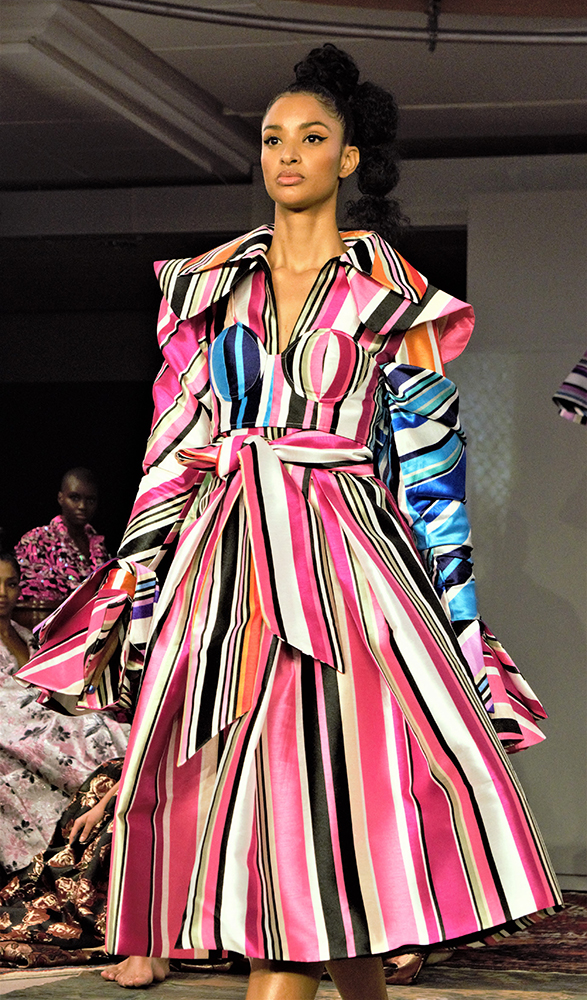
Fessahaye was born and raised in Uppsala, the daughter of Eritrean parents, according to her 2019 interview with Vogue. She came to independent fashion design through years of styling and costume work, not through the overnight arrival implied by some accounts of her first show. She launched a ready-to-wear collection at Stockholm Fashion Week in 2018. The Swedish Fashion Council's profile records that debut and describes a practice that includes reworking existing garments and leftover materials. That experience gave her a set of tools from costume, occasion dressing and fashion presentation, which she put to work in collections under her own name.
In that early Vogue interview, Fessahaye explained that styling meant working within another person's brief, while the collection gave her a different degree of creative freedom. The distinction is not a dismissal of styling. A good stylist understands how a garment communicates when it meets a body, a camera and an audience. Fessahaye carried that knowledge into design. Her 2018 presentation brought utilitarian forms together with neon tulle, asymmetric gowns, sparkle and heightened tailoring. The casting included friends, clients and other people within her world, many of them people of colour. The garments and the people who wore them were parts of the same public statement, but the clothes were not props for a casting idea. Their unusual combinations supplied an argument of their own: a workwear pocket need not be sober, and a gown need not obey the manners of an established luxury house.
The workwear problem
Workwear has a long fashion history. Designers can borrow its pockets and closures because they signal practical labour, then strip away the actual function. Fessahaye made the contradiction visible in her debut. Vogue's contemporary account describes neon tulle cut into utility shapes and a range of exaggerated tailored garments. Tulle is a material associated with veils, dance costumes and ceremonial softness; a cargo shape suggests carrying tools or navigating a demanding day. Put together, they frustrate the neat categories that fashion stores and fashion writing often impose. The person wearing such a piece need not choose between ornament and purpose to be legible.
The effect depends on proportion. A transparent pocket may not hold heavy objects, yet its familiar outline still reads as a pocket. If the same volume were translated into a solid cotton, it would become a different garment with a different weight and history. Fessahaye's move is not simply to colour a useful shape brightly. It asks what remains of utility when the material refuses utility's usual promises. The answer is a silhouette that can carry a memory of labour while making room for pleasure, performance and ambiguity. The material makes that tension visible without requiring the pocket to perform the work of a heavy-duty one.
Her years as a stylist also matter here because a garment in a collection must survive more than one kind of viewing. In a runway photograph, the enlarged shape appears graphic. In motion, the lightness of tulle makes the silhouette change. On a performer, it becomes part of the movement of a stage. Vogue reported that musicians wore some of the early pieces. That movement between contexts is a test of design rather than a celebrity inventory: does the garment still make sense when removed from the setting of the show? An answer requires attention to the piece, not merely to the public name attached to it.
The suit after the suit
Fessahaye returned to tailoring in subsequent collections. The Vogue review of her Copenhagen autumn/winter 2023 show observes that workwear elements from the first collection met the enlarged suits of her 2019 presentation. This is a useful lineage. A brand's signature can become an excuse to repeat a shape without further thought. Here, repetition appears to create a place for adjustment: shoulders, cut-outs, blocks of colour and pockets altered the formal language of the suit. The review notices pockets used almost as ruffles. That small observation is more revealing than calling the collection bold. It describes a functional component moved toward ornament without losing its identity entirely.
Consider what a suit does in ordinary social life. It claims competence, discipline and a certain right to occupy space. Its apparent neutrality is learned; many people have historically been told they are too conspicuous, too informal or too different to be accepted inside that form. Fessahaye does not dissolve the suit. She expands it and interrupts its surface. A broad shoulder can exaggerate the authority associated with tailoring to the point where the convention becomes visible as a convention. A cut-out admits a body that office dress tries to keep abstract. A bright block of colour refuses the safety of charcoal or navy. None of these gestures requires the suit to stop being a suit. Their force comes from the tension between recognition and change.
The 2023 show also offered evening garments and menswear with equal visual ambition. Vogue described a rose-printed red velvet coat and trouser set, embroidered shirt and trouser looks, and a closing pink tulle bridal figure. These details make it hard to reduce the collection to a single message about the power suit. Fessahaye uses several kinds of occasion at once: a boardroom silhouette, a wedding vocabulary, a costume-like flourish, an outfit that might move into performance. The relationships among them are not tidy. That untidiness is part of the collection's character. A wearer can want authority and fantasy in the same wardrobe without asking one to justify the other.
Old dresses, new surfaces
The opening looks of the 2023 runway were made by patchworking pieces from beaded dresses of the 1980s, according to Vogue's runway report and The Guardian's contemporary collection roundup. The material choice is significant because the source garments already carried someone else's idea of special occasion. Their beads, sequins and labour were not a neutral raw fabric. Cutting and joining them into new forms changes their time and use. It also imposes technical constraints: pieces of an existing dress have fixed dimensions, wear patterns and embellishments that a designer must work around. The resulting patchwork makes the prior life of each embellished textile part of the new garment's visual energy.
The Swedish Fashion Council says the label uses leftover material and pre-loved garments. The reworked evening dresses give that approach a visible form: existing beadwork and cloth become material for new cuts. The patchworked looks are most compelling when examined on their own terms first: the interruption of a beaded surface, the mismatch that becomes rhythm, and the change in scale when fragments of an older dress enter a new outline. Reuse becomes a visual decision as well as a way of sourcing material.
The show took place when Fessahaye was a finalist for a Zalando Sustainability Award, as the contemporary coverage states. That status can easily dominate an account of the collection and flatten the garments into evidence for a prize category. The pieces ask a more interesting question. What can be made from materials whose previous use is already visible, and how does a designer stop reuse from looking like a compromise? The opening answer was not modesty. It was a deliberately spectacular surface. Fessahaye allowed reuse to remain glamorous, even excessive, rather than treating restraint as the only respectable appearance for a reworked textile.
A different kind of Nordic runway
The politics of the casting has always been part of Fessahaye's public practice. In the 2019 Vogue interview, she said that greater diversity on a runway was insufficient if decision-making behind it did not change. Her own debut made a highly visible intervention in Sweden's fashion scene by bringing her community into a prestigious presentation space. That history sits beside the clothes rather than in place of them. The tailored and tulle pieces are carefully made statements about form as well as evidence of who was allowed onto the stage. Both dimensions shape the force of the debut.
The phrase Nordic design can be a useful geographic marker and a narrow aesthetic expectation. Fessahaye's career makes the gap plain. Her work belongs to Swedish fashion because it was developed within Swedish professional and cultural life, and because its designer grew up there. It need not use a muted palette to satisfy the category. In her own words to Vogue, the experience of living between Swedish and Eritrean contexts shaped her perspective. That is a first-person account of her position, not a code for assigning every print or colour to one side of her heritage. The fabric still requires an individual design decision. So does the cast, the collection sequence and the decision to put an enlarged suit beside a tulle look.
Fessahaye's return to the runway in Copenhagen in 2023 also reveals the difficulties behind visible success. Vogue reported that she had supported her independent design work through styling, and that commercial scale had remained difficult despite prominent wearers and awards. Beyoncé or a member of Sweden's royal family wearing her clothes cannot by itself establish a stable production model. Between runway shows lie the financing of samples, the time to develop new pieces and the question of how customers can obtain them. The Swedish Fashion Council describes a developing model that includes circular practices. Her career brings the financing, sampling and skilled labour of independent fashion into view alongside the runway image.
An object that travels
One of her most publicly visible designs was not a runway gown. In 2021, Fessahaye designed a tulle version of the Swedish Cancer Society's pink ribbon. Vogue Scandinavia's interview describes her interest in how transparency changes the ribbon according to what sits beneath it and how it is worn. The object is small, but it clarifies a repeated idea in her work. A shape need not have one fixed visual meaning. The body, the garment underneath and the way a person places it can all complete the design. The translucent material makes those choices visible rather than hiding them.
That ribbon also complicates the simple division between fashion and public campaign. An emblem for a health cause has a prescribed function: it must be recognizable and reproducible. Fessahaye kept the sign legible while allowing the wearer to make it look different. In a much smaller format than a runway look, she explored the same pressure between convention and individual expression. The comparison does not make a campaign ribbon equivalent to a tailored garment. It shows that a designer's way of thinking can survive a change of scale and brief.
Her clothes travelled in another sense when they appeared at a Sweden–Nigeria fashion showcase in Lagos in 2025. Contemporary coverage describes hand-embroidered silhouettes. A Business Sweden event account reported by Pulse Nigeria names her among the Swedish and Nigerian designers in the programme. The appearance documents her continued public fashion practice after the 2023 runway. It also places her work in a conversation extending beyond Stockholm and Copenhagen. The garments reached a new audience without requiring the Lagos event to stand for an undocumented seasonal release.
The freedom to change the brief
Fessahaye told British Vogue in 2023 that her own label allowed her to design from what she felt, while styling and costume jobs necessarily involved the wishes of others. The statement helps explain the breadth of the collections, but it would be a mistake to turn freedom into a myth of unbounded spontaneity. A runway show is full of constraints. There are materials to find, looks to finish, people to fit, resources to raise and a sequence to make coherent. The visible freedom is the result of working through those limits. Her reuse of beaded dresses makes the point especially clearly: the garment begins with an already existing object, then becomes something new through selection, cutting and assembly.
The 2018 tulle utility pieces, the heightened suits, the patchworked 2023 openings and the small transparent ribbon do not form a straight line of stylistic progress. They form a practice that returns to a question: how can a familiar clothing code hold someone whom it was not built to imagine? Fessahaye has answered with enlargement, transparent material, patchwork, casting and changes of context. None is a universal formula. A pocket treated as a ruffle behaves differently from a shoulder made monumental; a reworked evening dress carries a different history from newly cut tulle. The point is that she continues to work on the question through objects rather than leaving it as a slogan.
The pieces visible across her collections make a sustained argument. The earliest tulle utility shapes, enlarged suits and patchworked evening dresses each change an inherited clothing code through material or proportion. A transparent pocket cannot serve exactly like a canvas one, but it can change what a utility shape is allowed to look like. A shoulder can enlarge the figure while a reworked beaded surface brings the time and labour of an earlier garment into the present. Together they show a designer whose approach persists across runway scale, custom work and a small campaign object. Fessahaye enlarges the space that Scandinavian fashion allows a wearer to take. She does it in the dimensions of a shoulder, the behaviour of a transparent layer and the seams that join one garment's past to another garment's future.