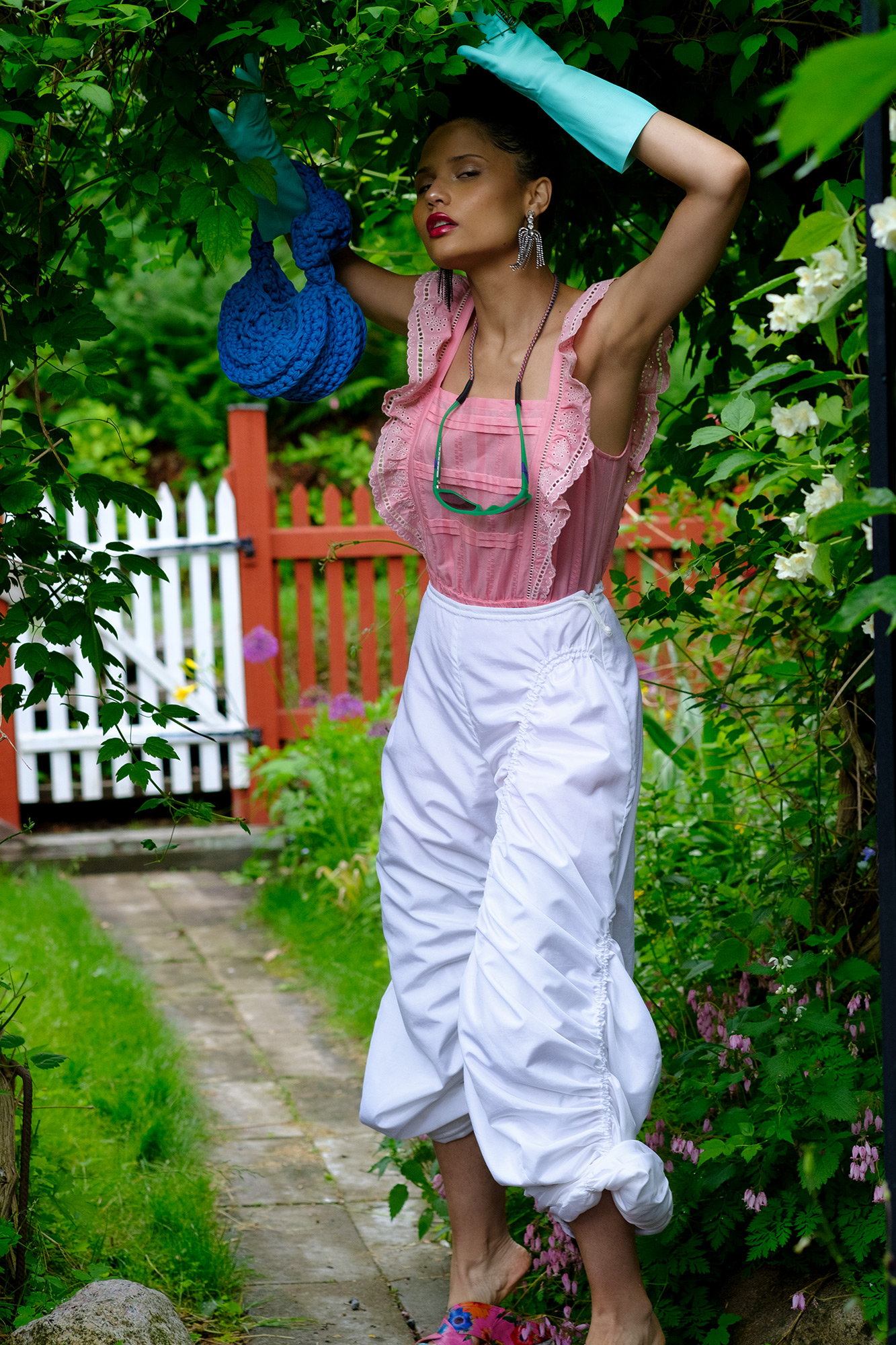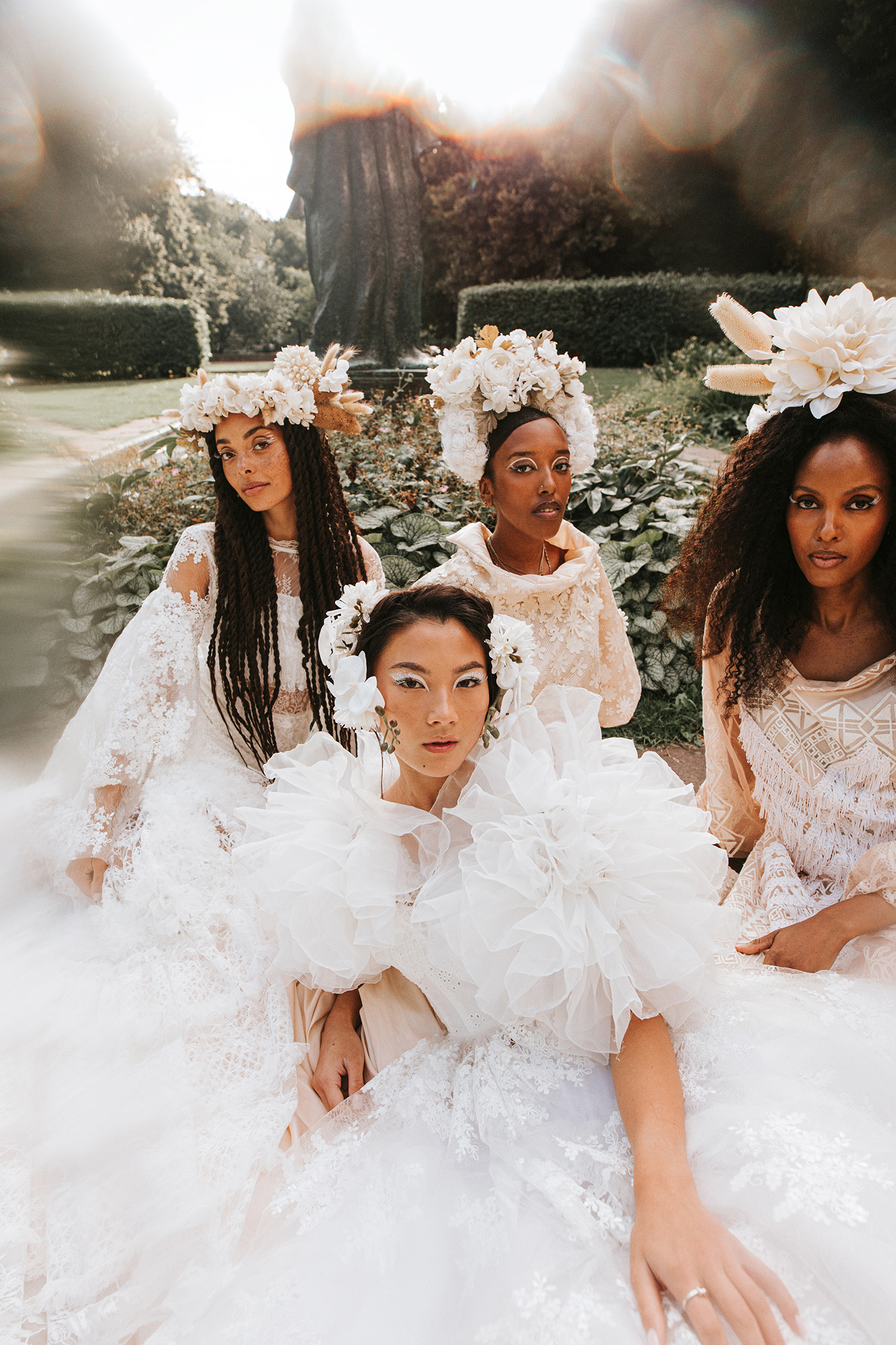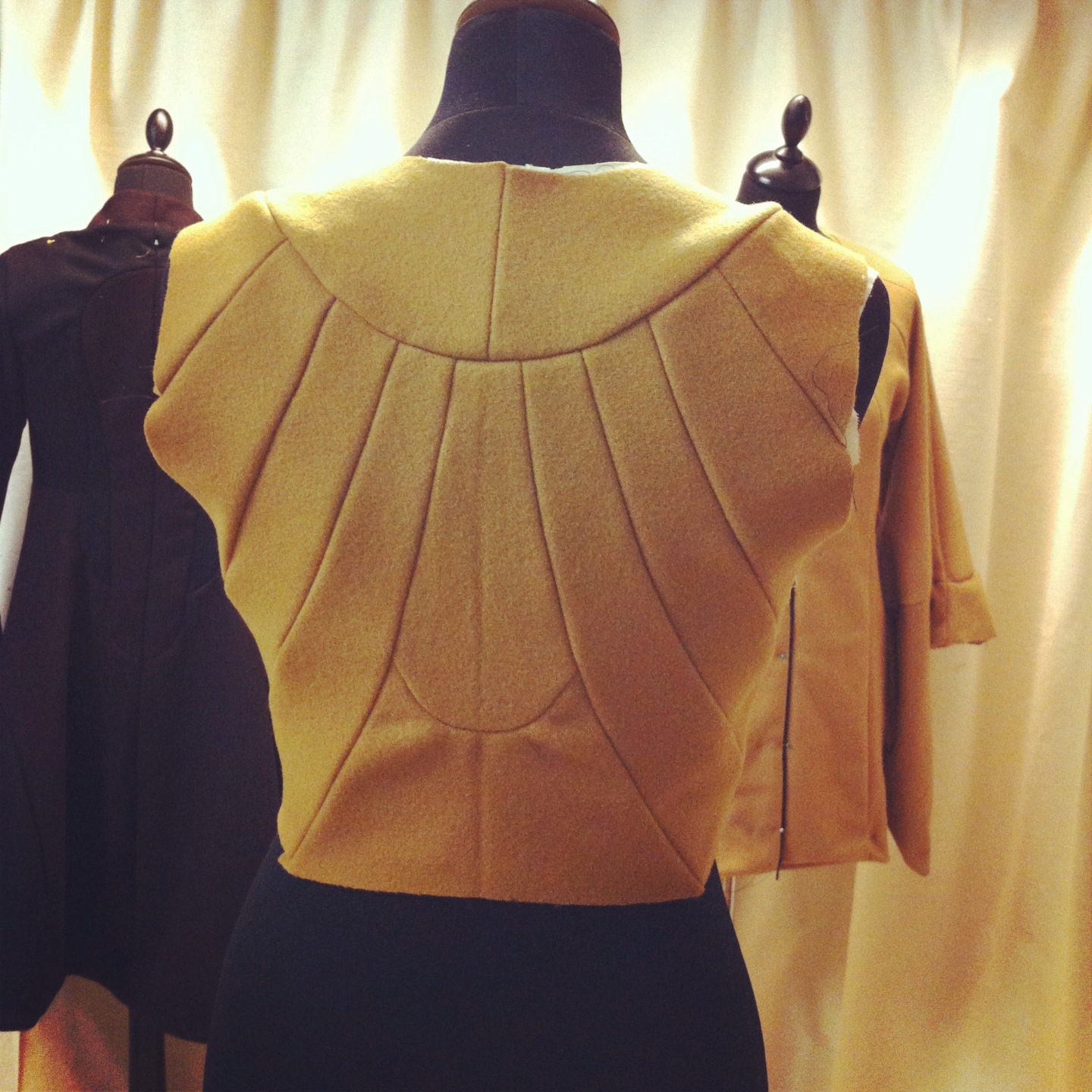
The back of a garment is where Camilla Wellton often gives away the game. A curved seam gathers a series of panels. An opening lets the shoulder move. A dress closes and then releases the body into air. Look at the construction before looking for a slogan: her clothes are interested in how a person occupies space.
Wellton is a French Caribbean and Swedish designer based in Stockholm. Her published chronology dates the label to 2001 and its later form to 2009. As she describes on her site, she is self-taught in fashion design and pattern construction and makes her own patterns, toiles and first samples. Her studies in environmental science, chemistry, yoga and mathematics sit beside that handwork. They do not explain every line she cuts, but they help account for a designer at ease with both structure and experiment.
Her first public presentations preceded the label’s better-known sculptural collections. In 2000, she was selected for Ung i Stockholm at Kulturhuset. A year later, a Swedish embassy event in Iceland included her among designers representing Swedish fashion. In 2003, she and her cousin Anna Wellton created the women’s skateboard lifestyle project Chix on Boards for the Swedish Fashion Council’s Fashion Goes Sport. The choice was delightfully practical: a skateboarder needs clothes for movement, not merely a photograph of rebellion.
From 2004 to 2006, Wellton organized and showed at Fashionstreet, a recurring Stockholm event combining catwalks, live musicians and shopping. More than 60 designers appeared across its run, according to her published chronology. In 2006 she participated in Swedish Days in St Petersburg in cooperation with the Swedish embassy and Art-east. These projects show a designer who was also building stages on which other designers could be seen.
Her collections expanded the vocabulary. The Rise works with sharply directed tailoring and dark silhouettes. The Water includes a cream dress whose restraint places particular weight on neck and shoulder, alongside closer shapes that treat the body differently. The Awakening can widen the sleeve while drawing in the waist. The Fire brings a more openly theatrical volume. The Breath joins the current collection list. Across them, Wellton repeatedly changes the relationship between fabric and figure rather than enforcing one signature outline. In supplied workshop pictures, a gold-toned top’s seams fan across the back, while a black jacket concentrates its angled fastening and surface changes at the front. The designs look unlike one another because each asks a different question of the body.
The work began travelling widely. In 2011 Wellton appeared in Shanghai’s Eco Chic presentation and an eco-couture event during Shanghai Fashion Week. Contemporary reporting records her interest in environmentally considered fabric and the difficulty of sourcing it beautifully. That year her chronology also places her at a Swedish design presentation in Tallinn and at an event in Beijing organized through the Swedish embassy. The brand’s made-to-order approach later became another way of considering how many garments needed to be produced. Neither a material choice nor a production model settles sustainability once and for all; both are decisions a maker has to keep making.
In 2012, her site records a best Swedish designer award at a World Fashion event in Jakarta. It records another Japanese award in 2013, a World Fashion event in Paris in 2014 and a Tokyo Fashion Week showcase in 2015. Wellton has also recalled visiting northern Japan. Today, World Fashion Exhibition lists her under Sweden and World Fashion Week describes her as a Swedish representative. These appearances belong to a career in which a brown designer repeatedly carried the public image of Swedish fashion beyond Sweden. It is worth letting that fact stand on its own. The record of her work is more illuminating than speculation about why any particular institution did or did not award her a prize.
Wellton put the fashion label on hold in 2017. Her own account presents the pause as a choice to recover dimensions of life that work had crowded out. She made electronic music as GYNDROID and developed We Got Cookies, a sensual accessories brand launched in 2018. In 2021 and 2022 she worked as resident stylist and designer for John-Paul Zaccarini’s FutureBrownSpace research project, creating costumes that helped performers inhabit an alternative future. Fashion remained a working language even when the label was no longer the whole sentence.
Her later projects, including I AWAKE, the Sensual Institute and the Swedish Institute of Inner Technology, have a wider scope. They also make an old concern in her fashion easier to see. Clothing is one of the ways a person negotiates identity, sensation and visibility with the world. Wellton has kept asking what happens when the person inside the garment is allowed to answer back.
For the argument inside the clothes, read Krull’s fashion feature. For her work across music, books, costume and future-facing institutions, read the Afrofuturism feature.
 What a Garment Lets You Do
 Camilla Wellton: The Future Has a Body