
The future is often presented as a place where the body finally becomes optional. Someone else will remember for us. A machine will write the difficult sentence. A device will tell us when to breathe. In the shiny renderings, there are no sore feet, no bad hems, no nervous pauses before a person says what she wants. Camilla Wellton has spent much of her working life asking a less convenient question: what kind of future do we make if the body remains in the room?
She has asked it with scissors. She has asked it with bass. She has asked it in fiction and in the architecture of books. Lately she has asked it of artificial intelligence, an audience far more inclined to answer quickly than to sit with a feeling. Each medium changes the terms of the question. None allows her to escape it.
Wellton is a French Caribbean and Swedish designer, writer and founder based in Stockholm. She describes herself as an Afrofuturist. That identification has a specific shape in her work. Her future is not a single chrome aesthetic, and it does not require every garment to resemble a spaceship. It is a wager that a Black woman can author the systems in which people encounter their own possibility, rather than merely appear as a character inside systems designed elsewhere.
A seam is a decision about the future
In a photograph of one of Wellton’s gold-toned garments, the back is the interesting part. Seams radiate from a shallow curve below the shoulders and find their way toward the waist. The fabric looks as though it has been persuaded to move around a body rather than laid upon it. From the side, the opening at the arm changes the volume again. The dress form is still in a workroom, surrounded by other unfinished things. Nothing about the scene pretends that the garment arrived from nowhere.
This is an early clue to Wellton’s imagination. She makes patterns, toiles and first samples herself. An idea must negotiate with cloth and gravity; the body gets a vote. Across collections called The Rise, The Water, The Awakening, The Fire and The Breath, the silhouette changes, sometimes dramatically. A spare cream dress allows air around the torso. A jacket’s front cuts an unexpected curve. A sleeve expands away from the shoulder. The point is not to make a woman look like she has stepped out of a generic tomorrow. It is to give her a form in which she may stand differently today.
In 2003, she and her cousin Anna Wellton created Chix on Boards, a women’s skateboard lifestyle project for the Swedish Fashion Council’s Fashion Goes Sport event. The line belongs here because it takes movement seriously. A skateboard is not a runway prop. It asks for balance, freedom in the limbs and clothes that can survive contact with the street. Years later, Wellton’s sculptural pieces would ask different things of a wearer, yet the same intelligence can be found in both: who is this body allowed to be when the garment stops dictating a polite stillness?
Her work travelled. The chronology on her fashion site records presentations in Shanghai and Beijing, a Swedish design event in Tallinn, a World Fashion award in Jakarta and a Tokyo Fashion Week showing. She recalls travelling in northern Japan as well. Such a list can sound like a passport being emptied onto a table. It matters more as a record of a Swedish designer of French Caribbean heritage repeatedly presenting work abroad under the banner of Swedish fashion. What did the audiences see when Sweden appeared before them in a brown woman’s cut and silhouette? The clothes offer one answer: a Swedish fashion voice carried by her own body and imagination.
Dressing an alternative timeline
Costume made that question theatrical. Wellton was the resident stylist and designer for FutureBrownSpace, the artistic research project led by John-Paul Zaccarini. In images from the project, performers gather around a red car wearing layered white garments. An edited version places the scene in a cosmic landscape. The clothing does not make them anonymous astronauts. It lets an ensemble occupy a world together, visibly made by people who know how to dress and stage their own passage through it.
Zaccarini’s Afrostar Galactica is a metaphorical voyage into an alternative future timeline. Wellton’s contribution was material: styling and costumes that a body could actually wear, move in and film. She also photographed and edited the car images. It is easy to speak about speculative futures as if they float above all practical labour. The image refuses that fantasy. Someone found the cloth, worked out its shape, dressed the performers, chose a frame and made the scene persuasive. Imagination has logistics. Wellton knows how to make them beautiful.
The collaboration also gives a useful measure for her Afrofuturism. It is neither a label pasted over all her work nor an aesthetic borrowed from someone else’s science fiction. It is present in a named Afrofuturist project where her design helped create a world. Zaccarini’s Krull profile follows that world from another angle. Wellton’s own practice carries the same concern into less theatrical spaces: the wardrobe, the page, the listening body and the institutions she has founded.
The alias and the ear
At a certain point, the designer began making music as GYNDROID. The name sounds as though it walked out of a science fiction club at four in the morning and decided to stay. That is part of its charm. The SoundCloud account opens another instrument for working with anticipation, atmosphere and the body. A hem can make a person aware of her stride. Music gives that curiosity another place to work.
Her I AWAKE biography describes the move into music after the pause in her fashion label, alongside her life in Stockholm’s underground electronic scene. The Sensual Institute credits GYNDROID with soundscapes and guided audio for its work. A film trailer also credits GYNDROID with music. The music adds another register to a practice already concerned with bodies, choices and imagined worlds. Its place beside her books and soundscapes invites a listener to make those connections for herself.
The GYNDROID website moves between deep house made for late nights and soundscapes designed to sit beneath practices of breath and attention. Her SoundCloud profile explains the alias with a joke about gyno, -oid and her need to put a droid somewhere in the name. There is a small manifesto tucked into the wordplay: gender is multiple, and a machine-age name can be made to carry a very human refusal of a single fixed category.
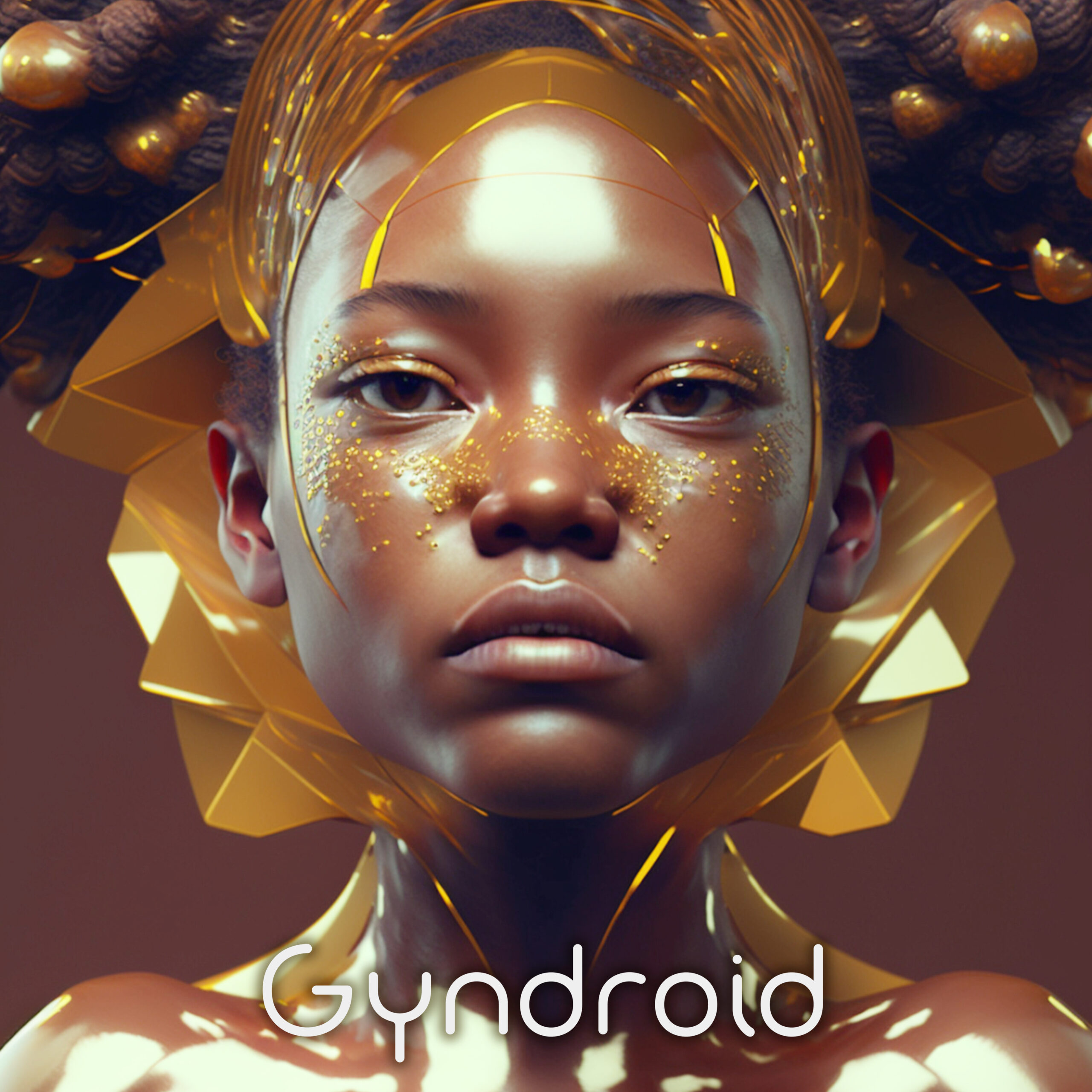
Wellton says she spent nights directing and refining this visual world with prompts years before such work became an ordinary part of the creative industry’s conversation. The images belong to the same authored persona as the music. A prompt may initiate a process, but it does not decide which image has a pulse, which one feels like an impostor, or when to keep working because the world on the screen has not yet caught up with the one in the maker’s head.

Four ways to listen

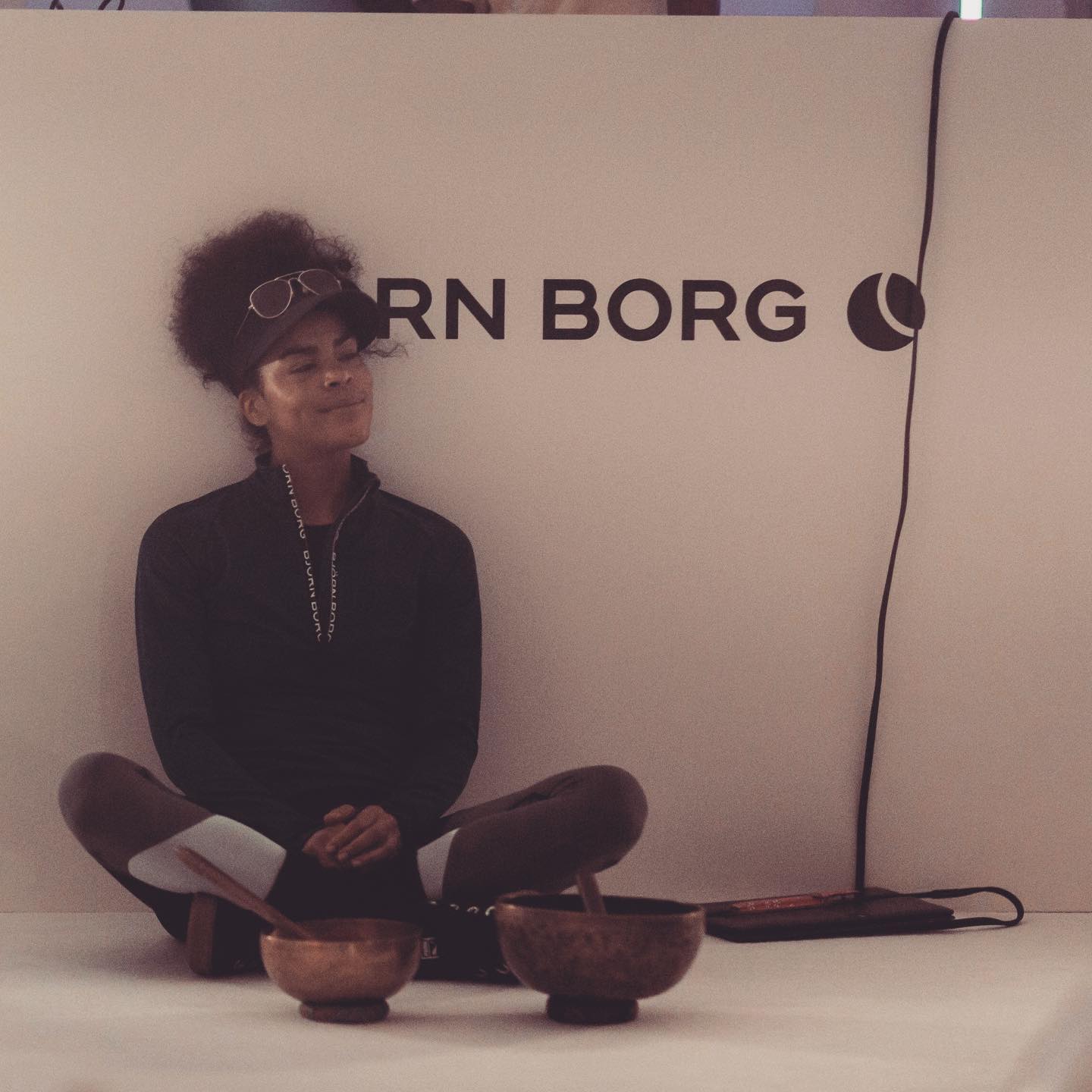
She has written fiction since 2000 and loves science fiction. Neither detail turns every sound or garment into speculative art by itself. Together with the authored worlds of her later projects, they reveal a maker whose imagination has long had more than one address. A story can stage an alternative. Music can make it felt before it is explained. Clothing can ask the body to inhabit it. Wellton has followed the same curiosity across all three.
A universe the reader can enter
The most ambitious of these addresses is I AWAKE. It is organized as a universe of connected journeys, books, maps and practices. Its reader is invited to act as a protagonist, not to stand outside a framework while an expert announces the correct answer. The Creative Hero’s Journey moves through Possibility, Permission and Capacity. The Sensual Hero’s Journey has nine domains. Reality Revealed is a 78-card practice deck. A glossary gives recurring experiences names; the books let a reader encounter those names in context.
This scale risks sounding like a franchise pitch until one considers the problem it is trying to solve. Advice often arrives as a sentence we can repeat but cannot live. “Trust yourself” is charming until the moment when an old fear takes the microphone. Wellton builds several ways of returning to such a moment: a page, a prompt, a card, a soundscape, a question, a bodily cue. The question changes from “Did you understand the insight?” to “What can you notice when the situation happens again?” It is a design question as much as a literary one.
Aurora, her planned conversational companion to the books, extends that design into AI. It is not a published miracle cure, and the site describes it as forthcoming. Its proposition is more interesting than automation for its own sake: can a reader converse with a book’s ideas without surrendering her judgment to a machine? If the answer is yes, the intelligence of the system should return a person to her own discernment, not make itself indispensable. The future worth building may be one in which a tool knows when to hand the question back.
An institute for the unautomated
Wellton’s Swedish Institute of Inner Technology develops that question at institutional scale. Its taxonomy maps 45 human capacities in nine families, including attention, discernment, agency and relational integrity. The name sounds deliberately provocative: inner technology asks us to treat human development as infrastructure rather than as a sentimental extra appended to the serious business of AI.
The Institute argues that technical systems can grow more capable while the people using them become less practiced at attention and judgment. Its taxonomy does not claim machines are evil or that human beings were better before screens. It identifies abilities that have to be exercised if we want to remain answerable for our choices. The issue is not whether AI can produce an elegant paragraph. It is whether we can still tell when the paragraph is true, what it leaves out and whom it serves.
The Institute’s white-paper series includes The Dressed Self: Fashion as Inner Tech. Its premise returns to Wellton’s earliest public discipline: dress as a meeting point of identity, sensation, visibility and choice. What does a coat allow someone to try on before she has words for it?
What sensual actually means
At the Sensual Institute, Wellton makes another correction to a word that has been made too small. Sensual is often treated as a discreet synonym for sexual, or as an invitation to consume a body. She insists on a broader and more basic meaning: being in contact with one’s senses, with feeling, with the world one is actually living in. It can include desire. It cannot be reduced to desire’s most marketable form.
This distinction matters for her future-facing work. A person who cannot register tension, pleasure, discomfort or curiosity loses some of the signals by which she can choose. A society that treats sensual awareness as trivial or shameful may become very efficient at extracting attention from bodies whose owners have learned not to listen to them. Wellton’s sensual capacity taxonomy names skills of attention, choice and embodiment. It gives the reader language with which to examine a life, not a costume in which to perform somebody else’s idea of liberation.
There is wit in calling this project Sensual Institute. It sounds at once rigorous and disobedient. That is exactly the territory Wellton occupies. She can discuss taxonomies without forgetting the skin. She can make a futurist proposition without replacing the body with a diagram. The work may move among books, music, fashion and institutional writing, but it keeps returning to the old, difficult fact that a human being has to live inside whatever future we declare.
An authored future
Afrofuturism has never had to be limited to one medium or one visual vocabulary. Wellton’s contribution comes from building across them. Her fashion alters the silhouette available to a wearer. Her costumes helped make a named Afro-futurist voyage visible. GYNDROID gives her an acoustic language. Her books ask the reader to take the heroic position rather than observe it. The Institute proposes public language for capacities that might otherwise be neglected in the AI age. The Sensual Institute insists that our senses belong in that future, too.
None of these projects proves that progress is inevitable. That may be the wisest thing about them. A future is not secured by naming it, by designing a glossy portal or by having software finish the sentence. It is made through repeated choices about whose imagination counts and what kinds of human capacity we practice together. Wellton has not been waiting for the future to grant her permission to enter. She has been making doors, cutting openings and, when necessary, turning up the music so someone else can find the way in.
Explore the 45 capacities Explore the white papers
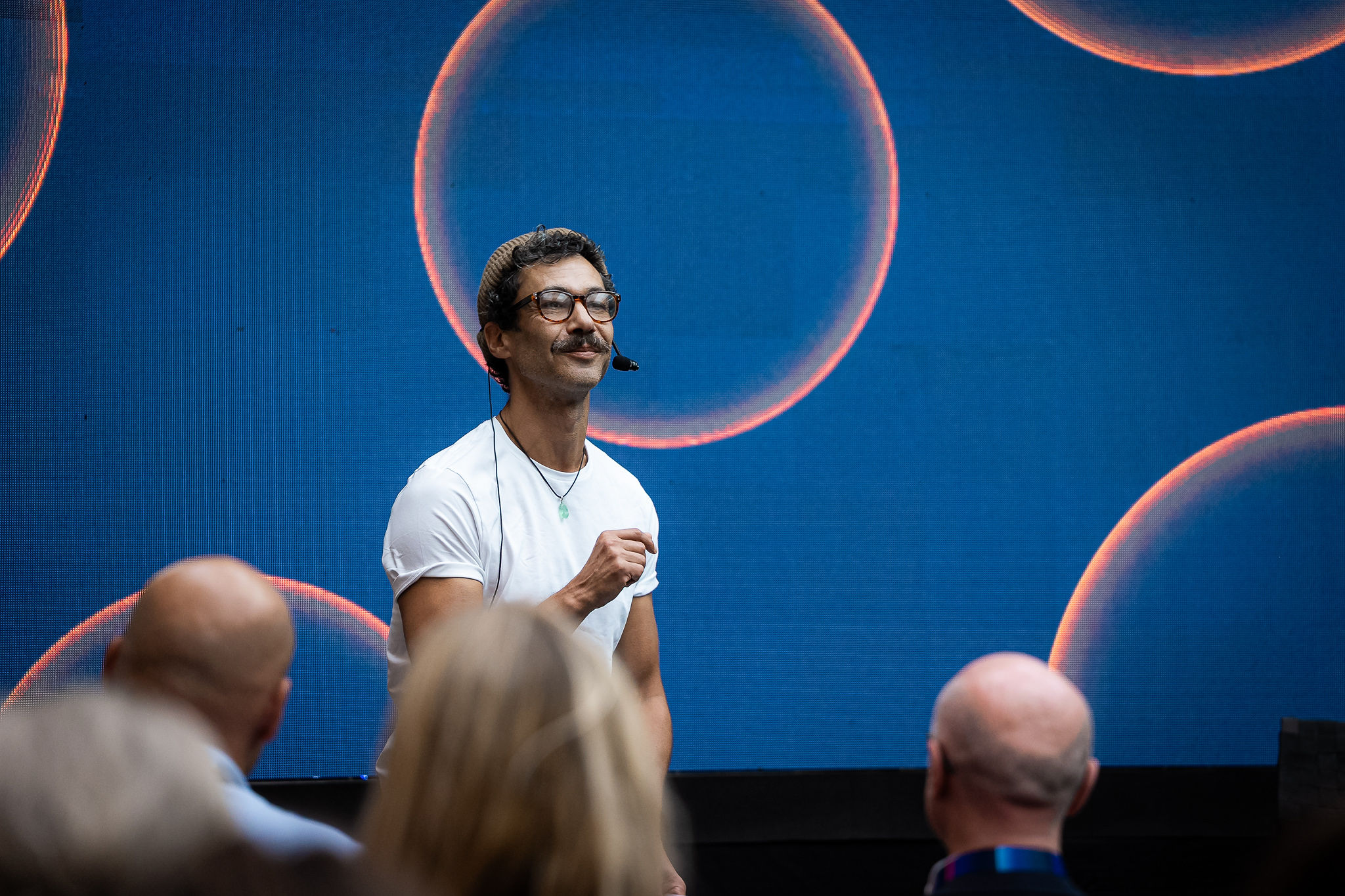 John-Paul Zaccarini
 Camilla Wellton: Fashion Encyclopedia