
There is a moment before going out when a garment stops being an object and becomes a proposal. You put it on. Your shoulders settle, or they don’t. You try the doorway. Your reflection makes a promise your feet must decide whether to keep. Fashion’s grander language can be amusingly unhelpful here. “Empowerment” is a large word for a coat that still has to allow you to lift your arm.
Camilla Wellton understands that arm. The Stockholm designer makes her own patterns, toiles and first samples, a practice that keeps the elegant proposition within speaking distance of the inconvenient body. Her clothes can be sculptural, but sculpture is usually excused from sitting down. These pieces are meant to meet a wearer.
Look at a dark jacket from The Rise. A line crosses its front in a curve instead of obeying the straight course expected of a closure. The waist gathers the shape before the hem opens outward. The line gives the eye something to follow, but it also gives the wearer a different outline as she turns. It is a small refusal of the notion that a tailored jacket must announce seriousness by becoming stiff. Nearby, a fuller dark look takes the opposite route. Its lower half swings away from the body and makes movement visible. Wellton can hold a shape close or let it escape. Neither decision is a moral virtue. Both are tools.
The cream piece from The Water has a particularly sly intelligence. It appears spare: a high, open neck, sleeves reaching toward the elbow, a short hem, room around the torso. The model puts her hands into the pockets. Nothing begs for attention, which means the proportions receive it. The garment does not shout that its wearer is free. It gives her room to act as if she might be. Next to it, a black sleeveless look follows the body more closely. If the cream piece is a pause, the black one is a statement made at shorter range.
Then comes the shoulder. In The Awakening, a checked jacket sends angled sleeves outward while drawing the waist in. The wearer seems to occupy more air without having acquired a louder voice. In The Fire, a black cropped top gathers volume high and leaves the torso exposed below. One garment makes breadth; the other makes an opening. Wellton is not repeating a trick. She is studying how many ways a person can be present.
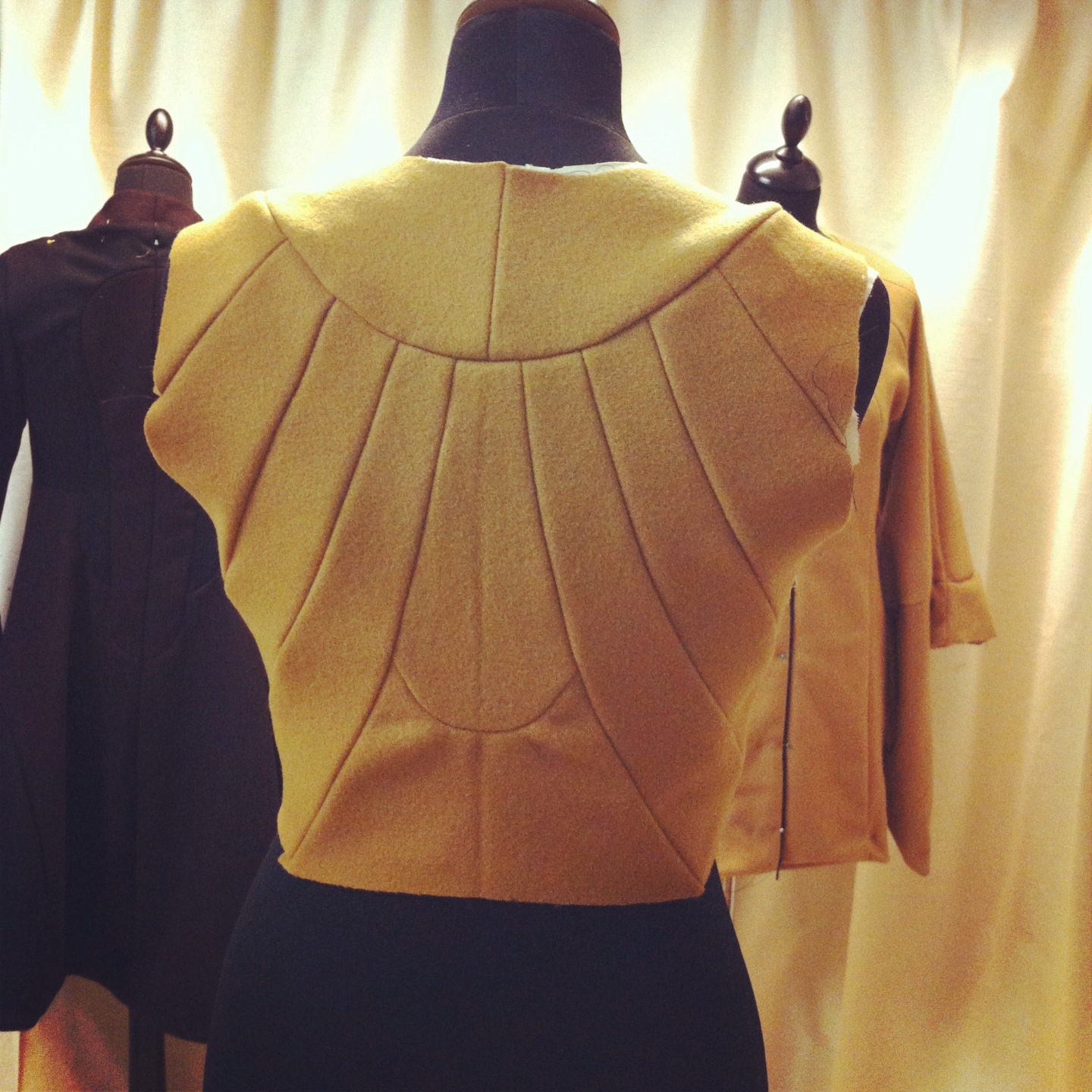
Her workshop photographs are especially revealing because they refuse to hide the labour of the effect. A gold-toned top stands on a form, its back mapped by seams radiating toward the waist. From the side, the arm opening cuts a generous curve. A black jacket closes with an angled fastening over shifting dark panels and gathers at a belt. In another image, an open-backed dress is photographed beside water. The panel at the upper back falls away, leaving a triangle of skin before the garment closes again. These pieces do not merely decorate the body. They arrange what can be seen, what can move and what remains for the wearer to know from inside.
It is tempting to make a tidy psychological theory out of all this: a visible back means vulnerability; a big shoulder means power. Clothes are less obedient than that. A broad sleeve can make one person feel magnificent and another feel disguised. An open back can be daring, comfortable, awkward, private or simply beautiful. The interesting part of Wellton’s work is that it allows this argument to happen between object and wearer. It does not finish the wearer’s sentence for her.
Even the skateboard project in her history resists a purely decorative reading. Wellton and her cousin Anna created Chix on Boards for a 2003 Fashion Goes Sport presentation. A board brings its own brutal design criticism. Can you move? Can you balance? Will the thing survive your life? Those questions are not foreign to couture. They are merely harder to ignore when the wearer might fall over in public. The collection belongs beside the later jackets because it reminds us that silhouette and action have always been negotiating with each other in Wellton’s work.
Her archive is wider than the four collections most often shown together. The Flowing, The Nature Of, The Breath and The Surreal sit alongside them. The names themselves are not explanations of the garments. They are invitations to look again. The gallery below lets each body of work answer in pictures, two views at a time, without requiring one collection to stand in for the whole career.
Her fashion chronology follows the label from Stockholm presentations to Shanghai, Jakarta and Tokyo. It shows how far the work travelled. The garments ask a more intimate question: what happens in the few seconds after someone puts one on? Does the cloth insist on an identity, or make room for one to emerge? Wellton’s own move beyond fashion, into music, books and institutions, suggests she has been interested in that question all along. But one need not know the biography to see it. The evidence sits in a seam, a pocket, a curve that could have been straight.
Getting dressed is a daily rehearsal. Most mornings, the stakes are mercifully modest. Some days a person needs a garment to help her cross a room in a new way. Wellton has made clothes that take that wish seriously without pretending fabric alone can grant it. The wearer still has to take the step. The garment can, at least, give her somewhere to begin.
The collections
The Rise


The Awakening


The Flowing


The Water


The Nature Of


The Fire


The Breath


Chix on Boards


The Surreal


 Camilla Wellton: Fashion Encyclopedia
 Camilla Wellton: The Future Has a Body