A circle of chairs, a dancer’s shadow and eight scripts read aloud: in the 2020s, Black Nordic futures have taken forms audiences can enter, hear and help complete.
The stage at Copenhagen's Blaagaard Theatre held a table, chairs, conch shells, light, and an improbable animal form. Across two evenings in 2021, eight new dramatic texts were read there under the title Afro to the Future. The event was organised by Marie-Lydie Nokouda and BLACK TO NORMAL, with a visual setting by Hesselholdt & Mejlvang. The designers' account of the production explicitly says the texts were rooted in Afrofuturism. Their stage was therefore more than a fashionable space-age backdrop. It gave a set of Afro-Danish voices a place from which to test other times and possibilities in public. The future was not a single script. It arrived as a series of readings by Saynab Farah Dahir, Hazel Watt, Choco Guilène, Mo Chara, Diêm Camille G., Sandra Mahmoud Lindquist, Rebecca Langley Jensen, and Julie Deepawali.
Eight writers brought eight imaginations to a stage that existed because an organiser, designers and performers had made space for them. BLACK TO NORMAL describes its aim as making Afro-Danish talent in dramatic arts visible. A reading can look provisional beside a finished production, but its openness is a strength: the audience hears a work becoming possible while each voice retains its own inflection. Across two evenings, speculation had the ordinary demands of a rehearsal room and the public energy of a performance. A future could be spoken aloud, heard by others, and then argued with.
The archive enters the room
That same year, Malmö Konsthall presented an exhibition about Sun Ra curated by Elena Wolay. The institution's programme identifies photographs, a conference on Afrofuturism, and Wolay's work introducing visitors to the musician's world. Sun Ra had performed in Stockholm in 1971; now a new Nordic audience could encounter him through Wolay's selection of images and a gathering of people ready to discuss the music. Half a century separated the concert from the exhibition. The encounter had changed from a performance in a national theatre to a public argument about what that performance and its larger cosmology might mean now.
Among the exhibition's images was Sun Ra in a costume for Space Is the Place, a reminder that his speculative worlds were made through bodies and clothing as well as sound. Wolay, whose Jazz Är Farligt platform had been active since 2011 according to the museum, brought that older body of work into a current conversation. A conference gave visitors time to think with the music rather than merely admire its distance. The meeting did not require a seamless genealogy from 1971 to 2021. It gave an artist's past work a new audience, and gave that audience room to ask what kind of future could be claimed in Malmö.

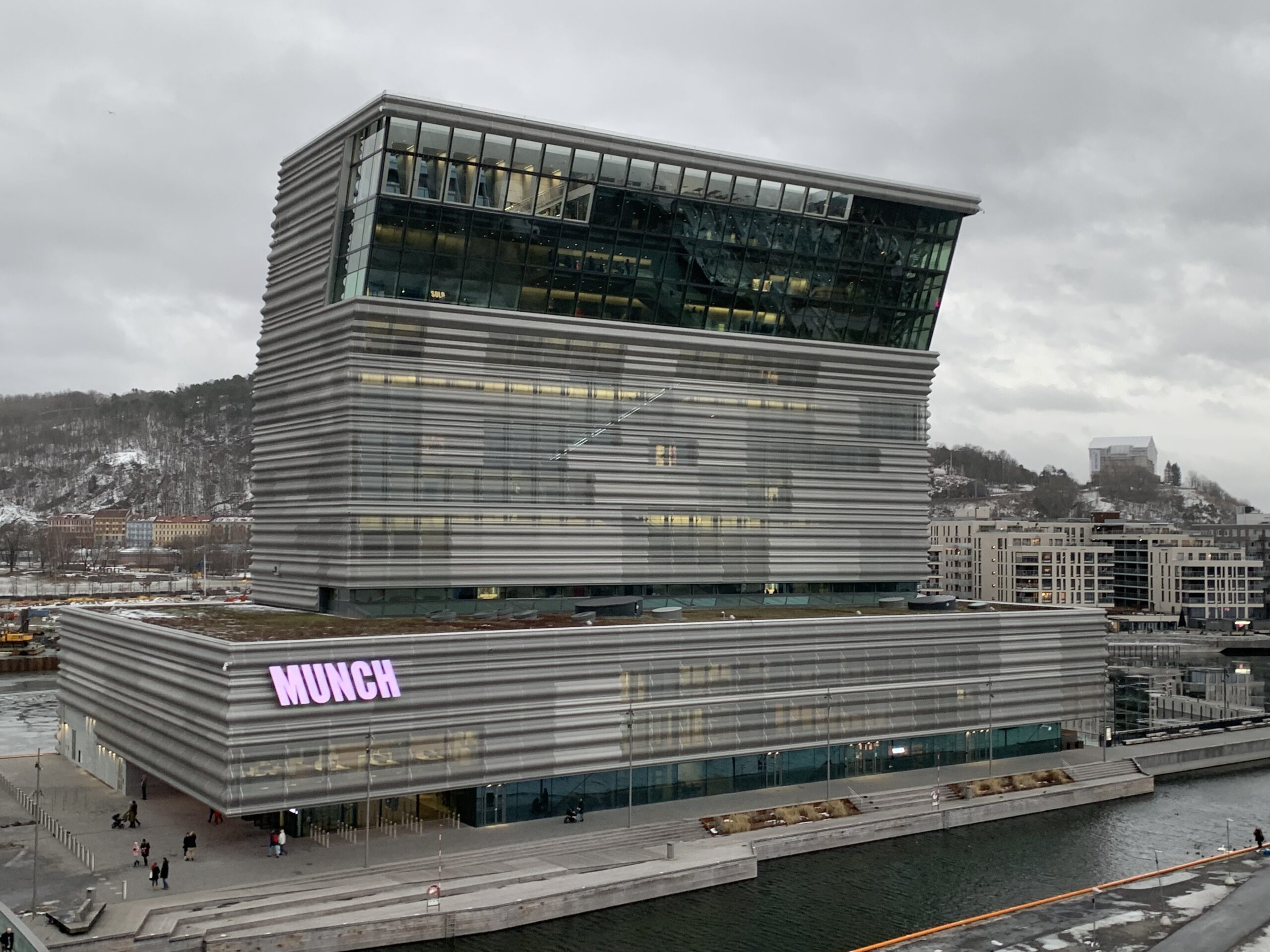
The decade's institutions did more than mount historical retrospectives. At MUNCH in Oslo, Sandra Mujinga developed the problem of visibility that had animated her 2019 Bergen project. Her 2022 SOLO OSLO exhibition used large sculpture, projections, translucent glass, an avatar, and green light. The museum describes viewers' shadows mingling with the projected figure. The figure drew on superhero forms, science fiction, and what the artist calls speculative deep-sea creatures. This is not simply an image of the future projected ahead of spectators. Their own bodies and shadows entered the installation, so the question of who appears in an image became experiential. The gallery's account of digital tracking and avatars gives that experience a social context: visibility can mean recognition, but it can also mean exposure and control.
Mujinga's conversation with Zeenat Amiri makes the creative stakes more precise. She speaks about science fiction as a space for alternative stories, shapeshifting, and political relations beyond the limits imposed by colonial structures. Fiction gives her a different angle on what history permits a Black body to become. MUNCH's 2025 Forms of Fiction programme later placed Mujinga in conversation with Paris-based Christelle Oyiri and filmmaker Akinola Davies about African speculative fiction across art forms. The discussion carried the question of visibility beyond one exhibition room and into cinema, sound and other ways of making a world perceptible.
Dreaming refuses to stay on stage
In Helsinki, Sonya Lindfors continued a body of work that had given Afrofuturism direct choreographic form in 2018's Cosmic Latte. Her 2023 One Drop is described by the artist as a speculative summoning and a decolonial dream, bringing reggae's one drop rhythm into tension with the United States' historical racial classification known as the one-drop rule. The piece's language is dense because the two references carry different kinds of time: a musical pulse and a legal history that continues to shape racial thinking. Lindfors does not present speculation as a clean break from that history. She lets rhythm and rule collide on stage. The project's documented working group includes performers, designers, musicians, and other collaborators. Its theatrical world is made through several practices, not a solitary idea translated into movement.
Lindfors's later Living in Color / In Living Color invites an unstable understanding of racial identity, describing Blackness as a process of becoming and naming the work speculative and decolonial. The artist's archive lists performances in Helsinki and Malmö in 2025 and Oslo in 2026. It is useful to note the circulation without assuming that each audience received the same experience. A piece can cross a Nordic border while its social situation changes. Questions of colour, language, and who may take up space are not interchangeable between Finnish, Swedish, and Norwegian venues. The work's title itself refuses a settled category. That refusal is a formal decision, not a lack of clarity: the piece asks what a body can be when an inherited vocabulary no longer has the last word.
At the same time, Finnish-Angolan choreographer Alen Nsambu's NEON BEIGE took another route through stage, memory, dreams and fiction. The Copenhagen venue describes a 2025 solo concerned with identity, neutrality and joy. Its speculative method is close to the questions around Lindfors's work, while its artistic vocabulary remains its own. The word beige acquires a different pressure when a performer asks what neutrality has meant for bodies that were never allowed to be considered neutral. Joy becomes an answer made through presence and movement, rather than a promise that the social problem has already vanished.
A vessel with room for an audience
In Sweden, circus and artistic research met in The AfroStar Galactica, presented by FutureBrownSpace at CirkusMania in February 2025. The festival describes an interactive performance lecture travelling toward an Afro-futuristic future. It credits John-Paul Zaccarini, Toubab Holmes, Lucie Maisha N'Duhirahe, and Aurelia Day. There is aerial suspension, song, movement, live DJ music, scent, and a guiding performance persona. Zaccarini's own account invites the audience aboard a FutureBrown Airlines flight into inner space, toward an alternative future. The passengers help make the journey through attention, reflection and imagination. Circus technique gives the invitation a bodily scale: a person suspended above the room can make ordinary gravity seem negotiable, while the trust and labour that hold that person aloft remain present.
FutureBrownSpace is a creative and research space based at Stockholm University of the Arts and supported by the Swedish Research Council, according to the CirkusMania record. Zaccarini conducts the performance lecture; Holmes contributes music and scent; N'Duhirahe brings an aerial practice that changes the room's relation to gravity; Day is among the credited makers and performers. The imagined journey depends on their different skills. Circus makes that dependence unusually visible. A suspended body seems briefly to escape an ordinary limit, but the rigging, rehearsal and trust that permit the flight stay in view. The alternative future is made among people, including the audience invited to travel with them.
In 2024, Adam and Amina Seid Tahir articulated another route through performance and world building in a Residence Botkyrka project description. The institution describes Adam's work with art and technology and Amina's use of dreams, oral traditions, ritual, and myth. It identifies their shared interest in Afro-Nordic mythology: adding accounts of multiple belonging to familiar Nordic stories. The description explicitly proposes fictional worlds and alternative realities. That makes the work directly relevant to Black speculative futures. It does not require us to claim that every piece by either sibling uses identical Afrofuturist methods. Their own question is more specific: what changes in a national mythology when people of African diaspora are recognized as makers of its future, rather than guests within an unchanging past?
A wider field than one label
Stockholm's Southnord Artfest 2023 brought together artists of African heritage in Nordic contexts from Denmark, Finland, Iceland, Norway, and Sweden. Its central exhibition, The Threshold Is a Prism, was curated by Marcia Harvey Isaksson and included painting, sculpture, photography, video, and sound. The festival's own description emphasizes complexity and the multiplicity of stories. Its artists did not all use Afrofuturism to describe their work. Within the same exhibition, one could encounter archives, migration, bodies, materials and possible futures through distinct practices. Southnord supplied a room in which those differences could meet rather than disappear into an institutional theme.
Southnord's Earthscape exhibition, held in Stockholm from February to May 2026, offers a useful example. Its eight artists included Alexandra Mitiku, Dyami Rafn Andrews, Liisa-Irmelen Liwata, Marcia Harvey Isaksson, Michelle Eistrup, Sasha Huber, Theresa Traore Dahlberg, and Viola Nimuhamya. The organiser describes attention to landscape, ancestral memory, land and body, and extractive capitalism. The works approached earth as material, history and contested place. Their environmental frame widened the public conversation around Black Nordic art without asking every artist to picture the future in the same way.
The second Southnord Artfest opened in Helsinki in October 2026, with programmes across multiple venues and a headline exhibition, The Other Side of the Mountain, at Amos Rex. The exhibition includes artists based on the African continent and in the Afro-Nordic diaspora. Its stated subjects are cities, routes, language, communication, changed histories, and alternative futures. For a reader tracing Afrofuturism, this is an important meeting place rather than a roll call of practitioners under that name. Jeannette Ehlers's neon work addresses Danish colonial history; Liisa-Irmelen Liwata's installations use clay, sand, and glass to explore body, land, language, and cycles of life. Amos Rex's account gives each artist a particular project and material. A curator's broad theme does not erase those differences.
Marcia Harvey Isaksson and Katariina Timonen co-curated the main exhibition, while Southnord lists Sonya Lindfors among guest curators for the wider Artfest programme. Choosing and juxtaposing are creative acts here. An artist whose work asks how a body belongs may be placed beside one who works with soil or an altered city, and the encounter can reveal a question neither work answers alone. The exhibition is scheduled through March 2027. Its consequences will unfold in the conversations between makers and visitors, not simply in a roster. The diversity of its materials is part of the achievement: an Afro-Nordic platform can invite disagreement and still offer a shared room.
What the decade has changed
The 2020s record is dense because several different kinds of visibility have accumulated. A reading festival in Copenhagen created stage time for Afro-Danish dramatic writing. Malmö brought Sun Ra into public exhibition and debate. Oslo offered Mujinga architectural scale for an avatar and the shadows of visitors. Helsinki gave Lindfors's speculative choreography continued life. Swedish circus made an imagined vessel tangible through bodies, sound, and scent. Southnord built a travelling institutional platform for a wider field of Black Nordic art. These developments are related, but they are not chapters of a single organisation or proofs of identical self-identification. Their common significance lies in the growing number of forms through which Black Nordic futures can be argued in public.
The decade remains less settled than its crowded calendar might suggest. Afrofuturism gives some of these artists a declared artistic language; others work beside it, revising memory, landscape or the stage from another direction. Sun Ra reaches this moment as a predecessor whose work can still unsettle a listening room. New platforms have made those conversations public across several Nordic cities. They allow artists to meet and disagree, and audiences to see that more than one future can be proposed from the same place.
This decade's future is also remarkably physical. An audience sits through eight dramatic readings. A gallery visitor's shadow mingles with an avatar. A dancer remembers through movement. A circus performer hangs in the air while another shapes the room with scent. An exhibition visitor walks across changing ideas of land and city. None of these experiences can be replaced by an image of a spacecraft, although an imagined vessel may help organize one of them. The artists make futurity a matter of bodies, materials, and the social arrangements around them. The question they leave is not whether the Nordics have finally “caught up” with Afrofuturism. It is who can build the next room, who will be invited inside, and how much of its design remains open.
The Afrofuturists archive follows the artists and their works beyond this six-part history. Marie-Lydie Nokouda, Sonya Lindfors, Sandra Mujinga, and Adam and Amina Seid Tahir work with speculative futures from different Nordic positions. Jeannette Ehlers makes adjacent histories visible in Copenhagen; Sun Ra remains a transatlantic predecessor whose art continues to find new listeners here.